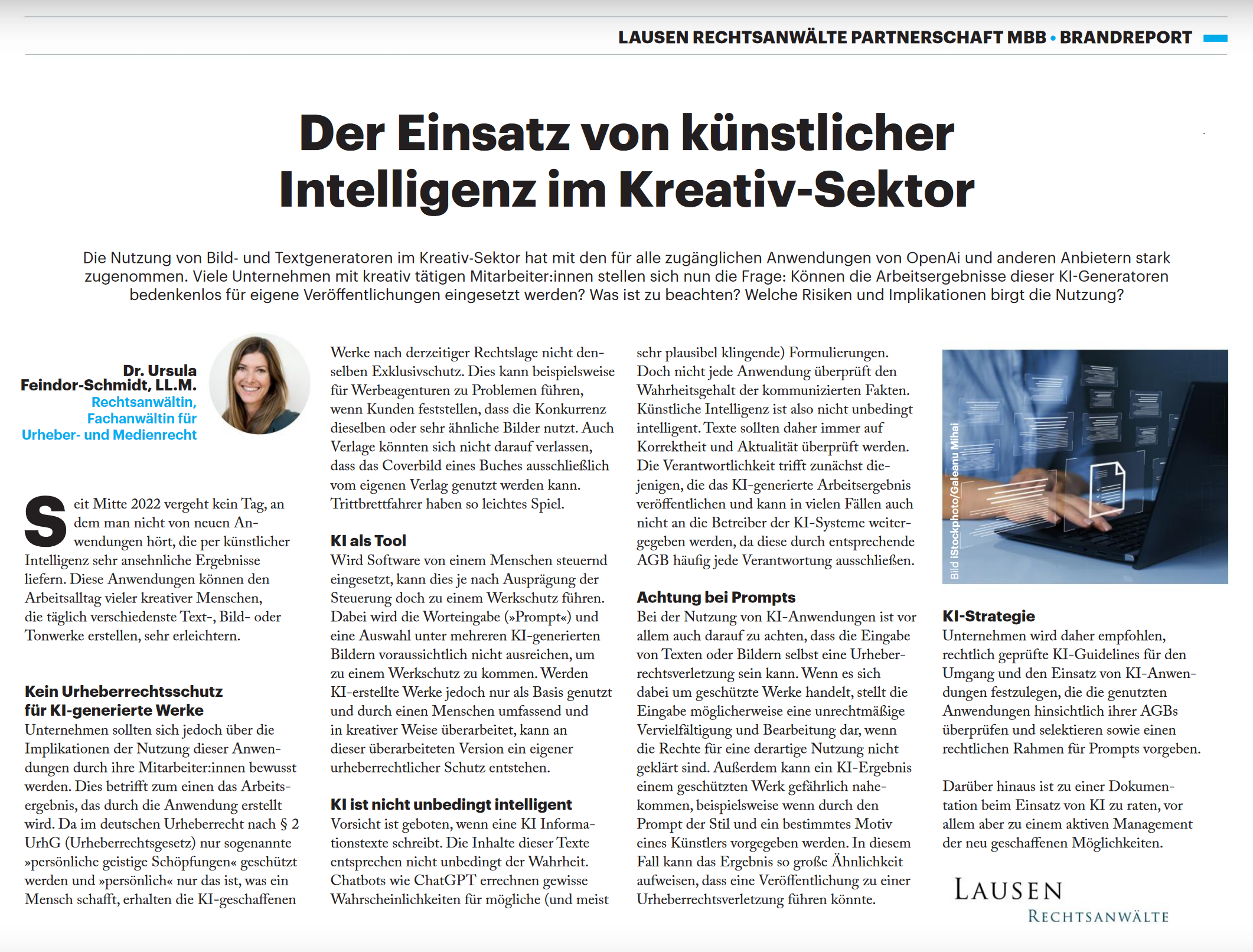
The use of artificial intelligence in the creative sector
Specialised Lawyer for Copyright and Media Law View profile


The use of image and text generators in the creative sector has increased sharply with the applications from OpenAi and other providers that are available to everyone. Many companies with creative employees are now asking themselves the question: Can the work results of these AI generators be used without hesitation for their own publications? What needs to be considered? What are the risks and implications of using those AI generated works?
Since mid-2022, not a day goes by without hearing about new applications that deliver very respectable results via artificial intelligence generation. These applications can greatly facilitate the daily work of many creative people who produce a wide variety of text, image or sound every day.
No copyright protection for AI-generated works
However, companies should be aware of the implications of the use of these applications by their employees. On the one hand, this concerns the work product created by the application. Since only so-called “personal intellectual creations” are protected (at least) according to German copyright law under Section 2 UrhG (Copyright Act), and “personal” is only what a human being creates, AI-generated works do not receive the same exclusive protection under the current legal situation. This can cause problems for advertising agencies, for example, when clients discover that competitors are using the same or very similar images. Publishers, too, would not be able to rely on the fact that the cover image of a book can only be used by them. Free riders thus have an easy game.
AI as a tool
On the other hand, if software is only used as a tool by a human which controls the system, protection might be possible, depending on the characteristics of the system. In connection with AI generated works, the text input (also known by “prompt”) and a selection from among several AI-generated images will probably not be sufficient to lead to a protection. However, if AI-generated works are used only as a basis and are extensively and creatively revised by a human being, this revised version may give rise to its own copyright protection and possibly to co-authorship.
AI is not necessarily intelligent
Caution is necessary when an AI writes informational text. The contents of these texts do not necessarily correspond to the truth and facts. Chatbots like ChatGPT calculate certain probabilities for possible (and usually very plausible sounding) wordings. But not every application verifies the truthfulness of the communicated facts. Artificial intelligence is therefore not necessarily intelligent. Texts should therefore always be checked for correctness and up-to-dateness by a human. Responsibility initially falls on the person who publishes the AI-generated work product and in many cases cannot be passed on to the operators of the AI systems either, as they often seek to exclude any responsibility by means of corresponding general terms and conditions.
Attention with prompts
When using AI applications, particular attention should also be paid to the fact that the input of text or images may itself constitutes a copyright infringement. If protected works are used in a prompt, this might constitute unlawful reproduction and adaptation if the rights for such use have not been cleared. In addition, an AI generated work result may be dangerously close to a protected work, for example, if the prompt specifies the style and a particular motif of an artist. In this case, the result may be seen as a derivative and its publication could lead to a copyright infringement.
AI strategy
Companies are therefore recommended to establish AI guidelines for the handling and use of AI applications, which review and select the applications used with regard to their terms and conditions and provide a legal framework for prompts that seeks a minimization of risk.
In addition, documentation is advised when using AI, but above all active management of the newly created opportunities.
This article was published in the SMART Legal Guide on March 21, 2023 in the daily newspaper “Die Welt”. To be found here, as well as in the supplement on page 13.