Copyright protection for AI-generated images
Specialised Lawyer for Copyright and Media Law View profile


The U.S. Copyright Office (USCO) recently recognised two images containing AI-generated elements as copyrightable works.
Starting point: USCO Report of 29 January 2025
The starting point is the second report of the US Copyright Office dated 29 January 2025, which deals in detail with the copyrightability of AI-generated content.
In summary, the report comes to the following conclusions:
- Questions of copyrightability and AI can be resolved pursuant to existing law, without the need for legislative change. At this stage, there is no evidence that additional copyright or sui generis protection is needed for AI-generated content.
- Copyright protects the original expression in a work created by a human author,
- even if the work also includes AI-generated material.
- Copyright does not extend to purely AI-generated material, or material where there is insufficient human control over the expressive elements.
- Whether human contributions to AI-generated outputs are sufficient to constitute authorship must be analyzed on a case-by-case basis.
- Based on the functioning of current generally available technology, prompts do not alone provide sufficient control.
- This is because prompts are instructions that convey non-protectable ideas. Even if very detailed prompts can contain the user’s desired elements of expression, they do not currently control how the AI system processes them when generating output. In particular, the fact that identical prompts can lead to several different outcomes further indicates a lack of human control, according to the USCO.
- However, a copyright for human authors in relation to AI-generated works may arise in the following constellations:
- human-created protected works, such as images, are loaded into an AI system as prompts and are (still) recognisable in the AI output; or
- AI output is modified by humans with sufficient originality that these human modifications are protected; or
- humans undertake the creative selection, coordination or arrangement of materials (such as AI elements) and thereby obtain copyright protection for the overall composition.
As an example of a possible human copyright in individual cases based on creative selection, coordination or arrangement, the report cites an AI tool often referred to as “inpainting”, which enables the concrete selection and placement of individual creative elements. In Midjourney, for example, this is the Midjourney’s ‘Vary Region and Remix’ feature, and Photoshop’s ‘Generative Fill’. In contrast to mere prompts, which do not allow sufficient control over the AI output, such AI tools can, in the opinion of the USCO, (sufficiently) control the selection and placement of individual creative elements. Whether such modifications meet a minimum standard of originality sufficient for copyright protection is, according to the USCO, a question for each individual case.
Decisions of the USCO
In a decision dated 30 January 2025, the Copyright Office now recognises copyright protection for the image “A Single Piece of American Cheese” for a specifically composed overall image composed of AI elements. Admittedly, all the individual elements of the image were AI-generated and therefore not eligible for copyright protection per se. Nevertheless, the applicant, Invoke AI, Inc. was granted copyright protection as ‘visual material’ on the basis that the sufficiently original selection and composition of the individual AI elements was worthy of protection. The entry in the register therefore also reads ‘selection, coordination and arrangement of material generated by artificial intelligence’. According to the registration, the individual AI-generated image components are expressly excluded from protection.
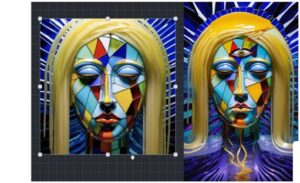
The second work protected as ‘visual material’, ‘A Collection of Objects Which Do Not Exist’ by an anonymous artist, registered by the USCO in February 2025, is also part of this argument. The reason given for the registration is ‘collage, selection and arrangement’, again explicitly excluding AI-generated pictorial elements from copyright protection.
Significance and practical advice
The protectability of AI-generated output is not entirely black and white, but must be considered on a case-by-case basis. While purely AI-generated output cannot claim copyright protection under Section 2 UrhG, this may be the case in part if the output still contains recognisable elements of human origin or the output contains processed human elements that are sufficiently creative.
In addition, the selection and arrangement of AI-generated elements may, in individual cases, have a degree of creativity of their own. This has already been decided by the Hanseatic Higher Regional Court, ZUM-RD 2013, 121, with regard to the protectability of collages, if the form of the collage design as such has a corresponding originality and degree of creativity.
In practice, against the background of these decisions, it is particularly important to create a high degree of transparency in the content creation process in which AI was used to generate content. The main aim is to document the nature and extent of the integration of AI tools as well as the human contribution to the content creation process.